Why You Have Good Stats but Keep Losing in Overwatch Ranked
The scoreboard shows what piled up over a match, not what mattered. Here is what good-looking numbers hide, and a replay checklist for the impact that actually wins fights.
Gold-medal damage, fewest deaths on the team, and a loss. Again. Sometimes your team really is the problem. But over many games, good stats on a losing record usually mean the numbers measure something that is not deciding the matches. The scoreboard shows what accumulated. It cannot show when, on whom, or whether it changed a single fight.
- Every scoreboard number is a total: no timing, no target, no context.
- Damage into a tank with two healers, or after the fight is lost, pads stats and wins nothing.
- Judge games by the moment each fight turned and whether you helped create, use or recover from it.
Goodhart’s Law, Overwatch Edition
Goodhart’s law: when a measure becomes a target, it stops being a good measure. Chase damage and you will find damage, usually on the target that gives it most freely. The scoreboard lists eliminations, assists, deaths, damage, healing and mitigation. All totals.
| Same number, very different value | Wins fights | Pads stats |
|---|---|---|
| Damage | The burst that forced their first death | Ten seconds into a tank after your team died |
| Healing | The heal that saved a dying support | Topping up a full-health tank |
| Eliminations | The pick that opened the objective | A kill on someone walking back from spawn |
| Low deaths | Surviving while pressuring | Surviving because you were never there |
Five Things Good Numbers Hide
Low deaths mean I’m playing well.
Only with presence. If your team keeps losing four against five while you live at the back, your survival is not helping.
Top damage means top impact.
Pouring damage into a well-supported tank builds numbers with no path to a kill. Look for a target your team can actually finish.
My kills prove I carried.
Ask what each one did. Late kills feel great but rarely change the next fight, because the enemy respawns grouped.
Big healing means I did my job.
Totals do not show prevented deaths, or the chances to pressure you skipped. Constant healing on non-threatening damage can let the enemy play freely.
Pocketed players post bigger numbers.
A player with a Mercy attached or constant healing usually does. Those stats came at the team’s cost and need to turn into won fights.
Measuring what is easy instead of what matters even has a name: the McNamara fallacy.
Aim Is One Part of the Job
Many good-stat players answer losses with more aim training. Better aim makes everything easier to execute, but it does not teach when to engage, which target matters, or what to do after a pick. If your accuracy is decent and you still lose, the gap is not in your crosshair.
You finish with 14,000 damage, mostly on their Reinhardt, and lose. Most likely problem?
- Your aim
- Your teammates’ damage
- Target choice: the tank had the most health and most healing on him
- Your sensitivity
Tank damage is the easiest number to build and one of the slowest ways to win a fight. A support or squishy in your range was probably worth more.
The Impact Checklist
Open the Replays tab in your Career Profile (replays clear after patches) and check three or four key fights:
| Question | Look for |
|---|---|
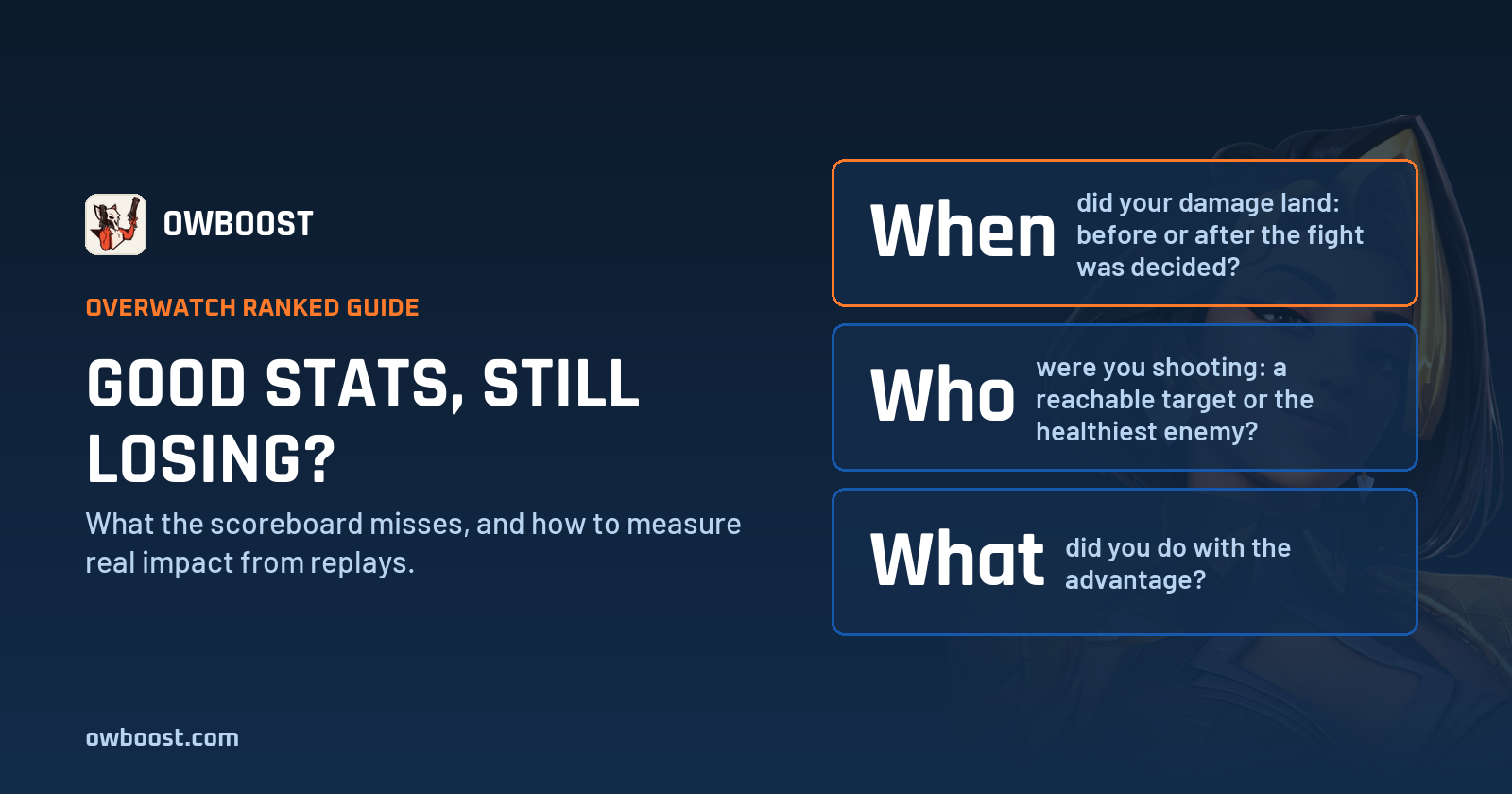
| When did I first apply pressure? | At the start, or once it was decided? |
| Did I force a key cooldown? | An escape, a defensive ability, an early save ult |
| When were my kills? | Early enough to create a numbers lead? |
| Who was I shooting? | A reachable target, or the healthiest enemy? |
| What did I receive? | Heals, a pocket, speed. Did my output justify it? |
| What after we got ahead? | Pushed, switched target, or chased? |
Turn each answer into one decision for next game. “Shoot the support when she’s in range instead of the tank” is practisable. “Do more damage” is not.
Find the Moment the Fight Turned
Almost every fight turns on one event: a first death, a big ult, a support caught. Then ask about your part:
- Did I help create it?
- Did I use it?
- If it went against us, did I help recover, or keep fighting a lost fight?
Players who climb do all three. Big-total, losing-record players often do their work outside that moment: before it, when nothing was at stake, or after, when it was gone. Over 50 to 100 games throwers spread across both teams evenly. If you sit at 50% with great stats, what you do well is not what decides your games. That is fixable.
Impact is hard to judge from inside your own game. Coaching with a Grandmaster or Top 500 coach starts with your replays and finds where your numbers are not turning into wins. Want the rank first? Rank boosting or duo boosting. Related: diagnosing a plateau and fight fixes for Gold and Platinum.
FAQ
Why do I lose with the most damage?
Totals hide timing and target. Damage into a heavily healed tank, or after the fight is lost, adds up without changing the result.
Does the scoreboard affect my rank?
No. Core Competitive rank comes from wins and losses, adjusted by labels like Uphill Battle and Reversal. Damage and healing do not change it directly.
Should I stop looking at the scoreboard?
No. Treat odd numbers as a prompt to check that game’s replay.
How do I know if I’m actually impacting games?
Watch the moments fights are decided. If you regularly help create, use or recover from them, you are having impact.
- Wikipedia: Goodhart’s law.
- Wikipedia: McNamara fallacy.
- Overwatch Wiki: Rank updates, what actually moves your rank.
- Wikipedia: Situation awareness.