
Overwatch Rank Progress Explained: Why You Gain Less Than You Lose
You are not being penalised. Uneven gains mean the game rates you below your badge, and it is pulling the badge down to meet you. Here is the break-even win rate that proves it, and what to do next.
The short answer: you are not being penalised. If your wins give +18% and your losses take −28%, the game rates you below your current badge and is pulling the badge down to meet that rating. It is a correction, it stops on its own, and you can calculate exactly how hard it is working against you.
- Uneven gains mean your rank sits above your hidden MMR. Blizzard keeps the two linked, so the badge is being moved towards the rating.
- At +18% / −28% you need a 60.9% win rate just to hold your rank. At 55% you drop a division about every 37 games.
- The gap closes by itself. As your rank meets your MMR, gains and losses even out again.
“Blizzard made losses bigger than wins, so you need to win way more than half your games just to climb.”
✕ Verdict: MisleadingLosses are only bigger while your rank sits above your MMR. It is a correction that switches off as the two meet, and the same rule gives underranked players huge gains. At +18% / −28%, holding your rank takes:
60.9% winsso 55% still loses a division every ~37 gamesThe Belief: “Blizzard Made Losses Bigger Than Wins”
It is one of the most repeated complaints in ranked threads: the system is built so you lose more than you gain, so the only way to climb is to win far more than half your games. Sometimes it comes with extra theories: old accounts are punished, spending money hurts you, or the game wants you stuck at 50%.
The observation is real. Plenty of players see small wins and big losses for weeks. The explanation is wrong. Gains and losses are not fixed to favour losses. They depend on the gap between two numbers, and that gap points in a direction you can identify.
Why It’s Wrong: Your Badge Chases Your Rating
Overwatch runs two numbers: your visible rank and a hidden MMR it uses to build matches. Blizzard has kept them linked in core Competitive since Overwatch 2 Season 9 and restated it in the February 2026 patch notes. The badge is always pulled towards the rating, the same catch-up idea as an Elo rating.
| Where your rank sits | Wins | Losses | What happens |
|---|---|---|---|
| Below your MMR | Bigger | Smaller | You climb fast |
| At your MMR | Even | Even | Win rate decides |
| Above your MMR | Smaller | Bigger | You get pulled down |
So “I lose more than I gain” does not describe the system. It describes your account right now, and it is the same rule that hands underranked players huge gains.
The Break-Even Win Rate: Why 55% Can Still Drop You
Here is the number that makes this concrete. The win rate you need just to hold your rank is:
Break-even win rateaverage loss ÷ (average gain + average loss). Win more often than that and you climb. Win less and you slide, even if you are winning most of your games.
Turn on JavaScript to use the calculator. Example: at +18% per win and −28% per loss, you need 60.9% wins to hold your rank.
The same formula for some common splits, worked out by us:
| Gain / loss per game | Win rate to hold rank | What it tells you |
|---|---|---|
| +28% / −18% | 39.1% | Well underranked: you climb even while losing more than you win |
| +30% / −20% | 40.0% | Underranked |
| +25% / −25% | 50.0% | Rank matches MMR |
| +20% / −25% | 55.6% | Slightly overranked |
| +18% / −28% | 60.9% | Overranked: 55% wins still loses a division every ~37 games |
| +15% / −30% | 66.7% | Well overranked |
At +18% / −28%, a 52% win rate costs about 4% a game (a division every ~25 games), 55% costs 2.7% a game (~37 games), and even 60% still slips 0.4% a game. That is why winning most of your games can feel pointless for a while. It is not pointless: every one of those games is moving rank and MMR closer together, and as they meet the split moves back towards 25 / 25.
What the Result Screen Is Telling You
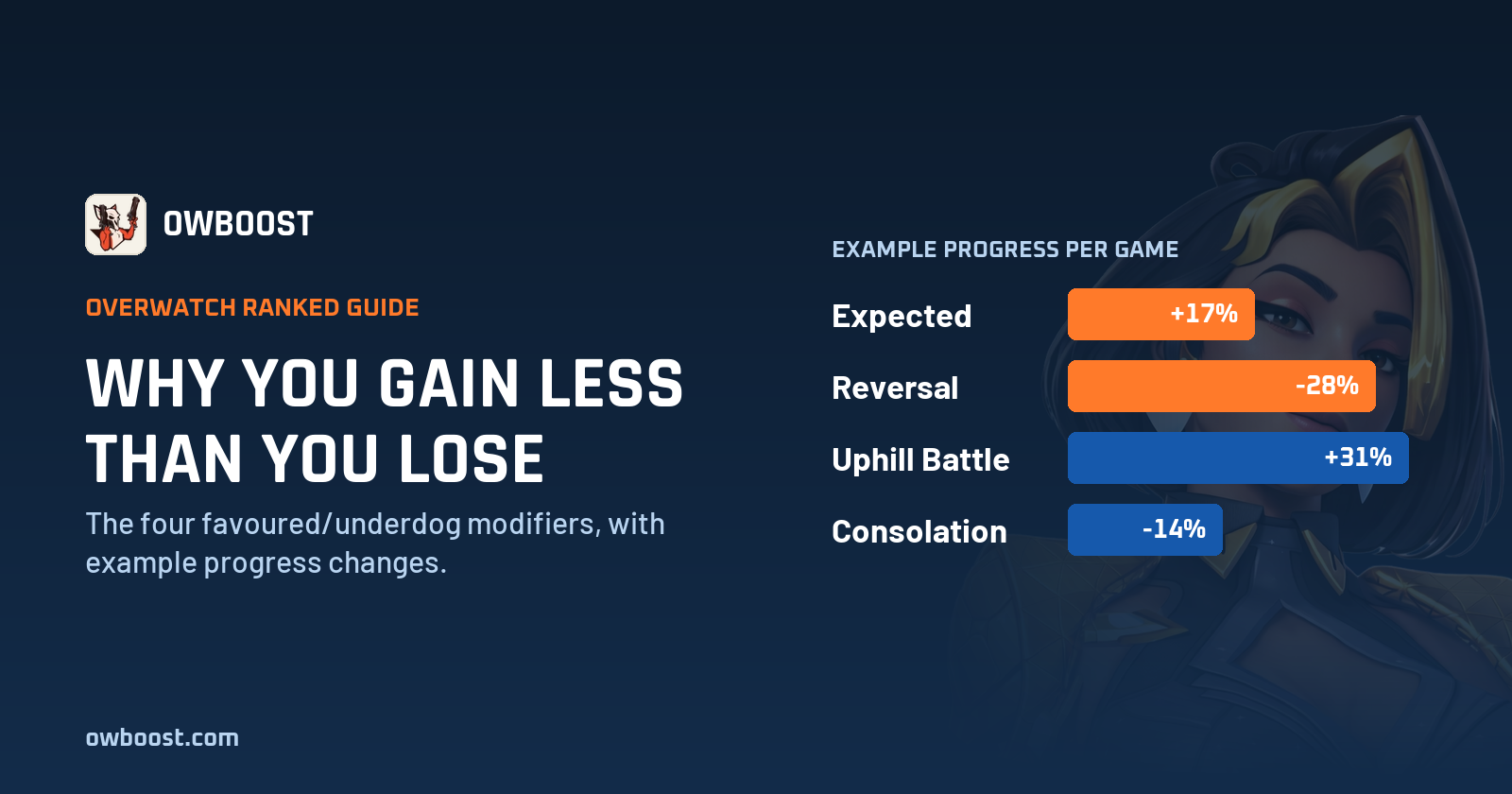
The labels under the progress bar show which side of the gap you are on. “Favoured” is decided before the match from the rating gap between the teams, not by how the game felt.
| Label | Situation | Effect |
|---|---|---|
| Expected | Favourite won | Smaller gain |
| Reversal | Favourite lost | Bigger loss |
| Uphill Battle | Underdog won | Bigger gain |
| Consolation | Underdog lost | Smaller loss |
| Calibration Up / Down | Rating uncertain, results leaning one way | Bigger swings |
| Wide | You queued in a wide group | Less change either way |
Weeks of Expected wins and Reversal losses is the overranked pattern: you keep being placed on the stronger side and dropping too many of those games. The Overwatch Wiki lists every label, including Pressure, Variance and Leaver Compensation.
Old accounts are penalised for being old.
No evidence. A returning account can feel penalised because its MMR was set when you played differently.
Spending money on skins lowers your gains.
Nothing shows purchases touching ranked progress.
The game forces a 50% win rate.
It builds even matches, which pulls you to about 50% at your real level. That is not the same as handing you losses.
Queueing with a much higher or lower friend shrinks your rank changes.
True. Wide groups get the Wide label and smaller gains and losses.
Which Rank-Progress Advice No Longer Applies?
A lot of the explanations still circulating were written for a different version of the ranked system. Check the date before trusting them.
| Older advice | Why it is out of date |
|---|---|
| “Check your SR number after each game” | Numeric SR is no longer shown. Progress is a percentage within a division. |
| “Your rank only moves after a batch of wins or losses” | That was the system before Overwatch 2 Season 9. Rank now updates after every match. |
| “Win Streak and Loss Streak modifiers” | The current labels are Calibration Up and Calibration Down, shown while your rating is uncertain. |
| “High Plat is one step from Diamond” | Emerald now sits between them, added on August 11, 2026. |
What To Do About It: The 20-Game Test
Keep one role, one queue and one grouping. Log the result, the progress change and every label for 20 games. Then plug your average gain and loss into the calculator above.
- Break-even above your win rate: you are overranked. Keep playing normally; the badge settles where you perform and the split evens out.
- Break-even near 50%: rank matches MMR. Only a higher win rate moves you now. See how long it takes to rank up.
- Break-even well below 50%: you are underranked. Play more; the game is catching up.
You gain 20% per win and lose 25% per loss. What win rate holds your rank?
- 50%
- About 56%
- 60%
- 75%
25 ÷ (20 + 25) = 55.6%. Below that you slide; above it you climb.
Looks like a bug?A loss that moves you up, or a label that contradicts the result, is worth reporting. Screenshot the result screen, note mode, role and time, and post it on the official Overwatch bug report forum.
Stuck being corrected every game? Coaching with a Grandmaster or Top 500 coach finds the habits behind those Reversal losses. Or skip the grind: our rank boosting and win boosting win real games, so rank and MMR rise together.
FAQ
Why do I gain less SR than I lose in Overwatch?
Your rank sits above your MMR, so the game is pulling it down. Overwatch no longer shows SR, but the percentage on the result screen works the same way.
What win rate do I need to rank up if I lose more than I gain?
More than your break-even rate: average loss ÷ (average gain + average loss). At +18% / −28% that is 60.9%.
How long until my gains go back to normal?
Usually a few dozen games at your normal level. Each result moves rank and MMR closer, and the split evens out as they meet.
Is Expected a bad label?
Not alone. It means your team was favoured and won. It only matters alongside lots of Reversal losses.
- Blizzard patch notes, February 2026: rank and MMR stay linked.
- Blizzard: Season 9 competitive changes, rank updates after every match.
- Overwatch Wiki: Rank updates, every result-screen label.
- Wikipedia: Elo rating system.
- Break-even formula and tables: our own arithmetic, assuming fixed average gains and losses.
- Change log: checked against Season 5 (A Grim Doctrine), October 2026. Review again when Season 6 launches.