
How Long Does It Take to Rank Up in Overwatch? Games, Win Rates and Time
There is no fixed number of wins per rank. Your climb speed is one formula: win rate, gains vs losses, games per week. Plug yours in below.
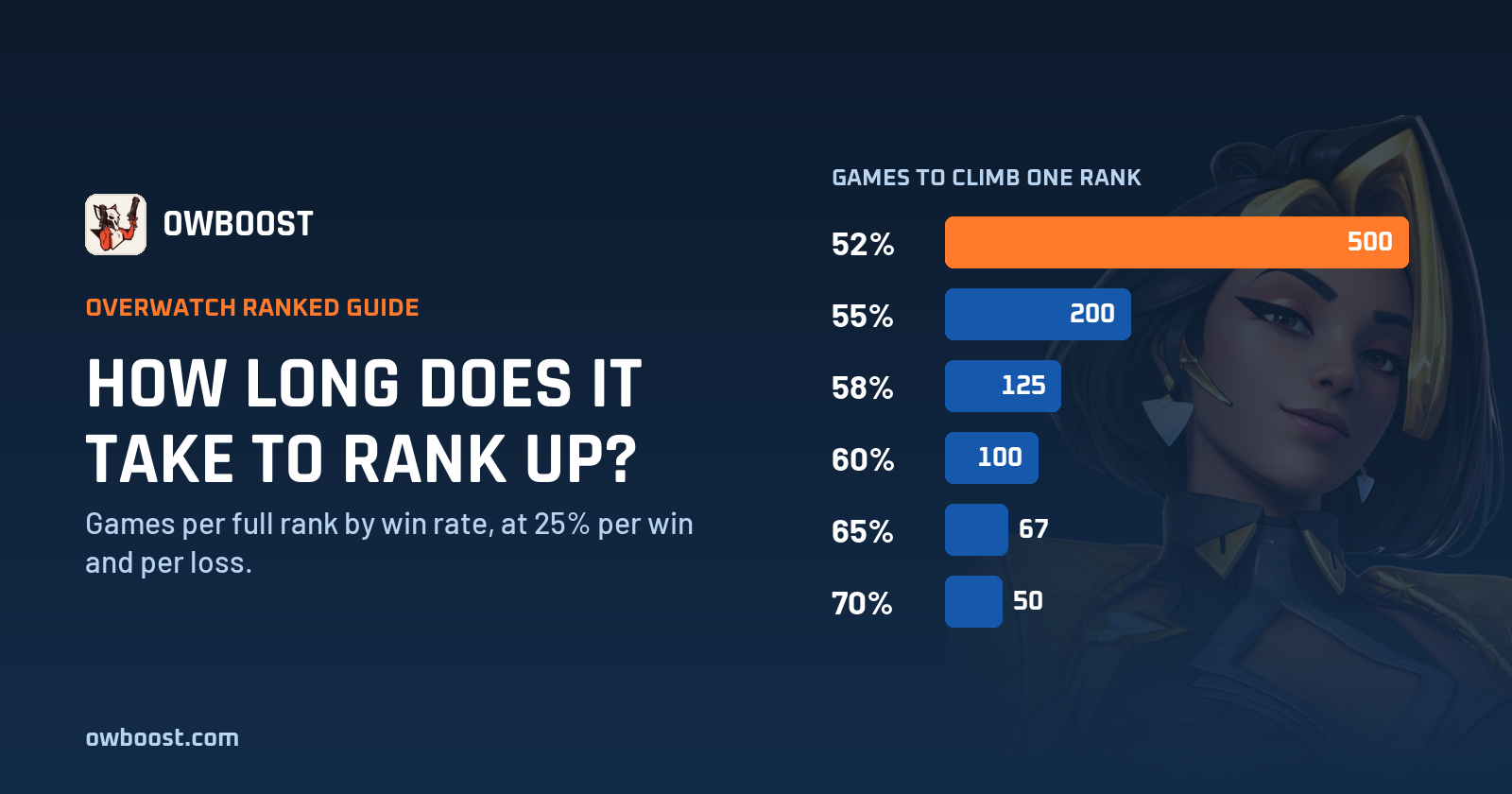
There is no fixed number of wins per rank. Anyone quoting one is guessing. Climb speed is a formula with three inputs: how often you win, what a win gives vs what a loss takes, and how many games you play. Get those and you get your answer.
- At a 55% win rate with even gains, expect about 40 games per division and 200 per rank.
- Going from 52% to 55% cuts a rank from ~500 games to ~200. Small edges are everything.
- Uneven gains mean your rank and hidden MMR disagree. That changes the maths more than any tip.
The Formula Behind Every Climb
Each division is a bar from 0 to 100%. Your expected progress per game is a plain expected value:
Net progress per game(win rate × average gain) − (loss rate × average loss). Divide 100% by it for games per division, multiply by 5 for a full rank.
Thirty wins can mean a big climb or none. It depends entirely on the losses next to them.
Run Your Own Numbers
Drag the sliders to match your last 20 games. Your gain and loss per game are on the result screen after every match.
Turn on JavaScript to use the calculator. Quick rule: at 25% per win and per loss, 55% wins is about 40 games per division.
The 3% Rule: Small Edges, Huge Savings
Same 25% gain and loss, different win rates. Look at the top two rows.
Three points of win rate, 60% less grinding. It is also why estimates built on 51% or 52% collapse: shift the input by one point and the answer doubles.
Why Your Gains Aren’t Symmetric
Rank and hidden MMR are linked, and Blizzard restated it in February 2026. Your badge is always pulled towards your MMR, the same idea as an Elo or Glicko rating catching up with results. The result screen labels it:
| Label | Means | Effect |
|---|---|---|
| Uphill Battle | Won as the underdog | Bigger gain |
| Expected | Won as the favourite | Smaller gain |
| Consolation | Lost as the underdog | Smaller loss |
| Reversal | Lost as the favourite | Bigger loss |
| Calibration Up / Down | Rank uncertain, results leaning one way | Bigger swings |
Lots of Uphill Battle wins means you are underranked and will beat the table above. Lots of Expected and Reversal means the game thinks your badge is too high. The Overwatch Wiki lists every label.
Regression to the Mean Is Coming for Your Win Rate
The matchmaker builds even games. As you climb towards your real level, opponents improve and your win rate slides back to 50%. That is regression toward the mean doing its job.
So “how long until Diamond?” is two questions. How long until my rank reaches my skill (fast, just games)? And how long until my skill reaches Diamond (slow, learning)? A hundred games at 50% in one tier means you have found your level. More games played the same way will not move it.
You win 55% of games and each win or loss moves you 25%. Roughly how many games per division?
- 10
- 20
- 40
- 100
40. Net progress is 0.55 × 25 − 0.45 × 25 = 2.5% a game, and 100 ÷ 2.5 = 40.
Four Players, Four Timelines
| Player | Typical pattern | Realistic pace |
|---|---|---|
| Returning after a break | MMR above badge, big gains | Dozens of games, not hundreds |
| Steady improver | 52 to 55% win rate | About one rank a season |
| Smurf or booster | 70%+ with Uphill Battle bonuses | A rank in a couple of days |
| Brand new account | 50 wins to unlock, then 10 placements per role | Unlock alone is ~100 games |
Seasons run about eight to nine weeks (Season 5 began October 6). Do not measure yourself against the smurf row: that is someone who already has the skill, not someone learning it. New-account numbers are from the May 12, 2026 patch, which raised the unlock from 20 to 50 wins.
How to Shrink the Number
- Stop before a bad session snowballs. Two losses in a row is a sensible exit.
- Climb on your best role. Role ranks are separate. Use the one that holds.
- Two or three heroes per role. Fewer decisions about kits, more attention for the fight.
- Review one close loss per session. One fixed habit beats fifty extra games.
Rather spend the hours elsewhere? Our Overwatch boosting is played by Grandmaster and Top 500 players, averaging about a tier per day. Want to climb yourself, faster? Coaching attacks the win rate directly, and duo boosting puts a high-ranked teammate in your games. See where you stand in our rank distribution breakdown.
FAQ
How many wins does it take to rank up in Overwatch?
No fixed number. If wins and losses each move you about 25%, you need four more wins than losses per division.
How much rank do you gain per win?
It varies. The result screen shows the exact percentage. Gains are bigger when your MMR is above your rank or you win as the underdog.
Why am I winning more than I lose but not ranking up?
Your gains are smaller than your losses because the game rates you below your badge. Log 20 games with their labels and it shows up fast.
How long is an Overwatch season?
About eight to nine weeks in 2026. Season 5 started on October 6.
- Blizzard patch notes, August 2026: Emerald added between Platinum and Diamond.
- Blizzard patch notes, May 2026: unlock raised to 50 wins.
- Overwatch Wiki: Competitive Play, tiers, divisions and rank update labels.
- Wikipedia: Elo rating system, the idea behind rating catch-up.
- Wikipedia: Regression toward the mean.